Saturday, 18 April 2020

Generic research: Textual Analysis 2

The Bad Guy

My second choice of media piece to aid the production of my own documentary is one based on the Scottish athlete Chris Bungard, and his success and training for his sport of mixed martial arts, and the buildup to his fight with Terry Brazier.
This documentary was up close and personal, showing every aspect to the talent's day, which is something that I would wish to portray to my audience.

The main aspects I highlighted as important or interesting during the documentary:

- In this documentary it is far more of a personal stance in the way that it is shown. There is no presenter, only clips put together of Bungard explaining his routines, as well as interviews with his friends, team mates, and coaches.  Although this was different to the newsbeat documentary in the way of how it is presented and it worked, I will still have a presenter to fulfil the brief of having two people within my 3 minute opening.
- Mixed martial arts and its dangers is established, this is not a sport I had heard about before, and for some of my audience it will be similar to this for horse riding. It will be important that I establish a grounding of what the sport is within my opening sequences.
- The documentary analysed his opponents, which may not be as achievable as how they conducted it, as it is a much wider field in showjumping.
- There is huge amounts of behind the scenes in the documentary, from his home in Scotland, training in Ireland, and the night before the fight. This gave plenty of options for shot types in the different locations, which I would like to achieve also to make it more interesting and varied for the audience.
- Interviews made a large part of the documentary, with family, friends, and coaches. This is something achievable within my documentary, as well as online if it is unable to be placed within the 3 minute opening, as it could be an opportunity for a 'team' aspect and getting to know them.
- The documentary does not focus purely on mixed martial arts, but also swimming, running and weightlifting that Bungard took part in to ensure peak performance. This is something that may be good to include in my documentary as well as online as it could open a 'how to keep fit' for this type of sport, and Harry (my talent) giving his opinion on what is best.
Some screenshots of the opening few minutes of 'The Bad Guy':
                                                                                The opening of the documentary is a series of different shots of the talent, Chris Bungard. The body language he portrays emphasises his confidence and power within the arena, and so that he is a well respected man at martial arts.


The title is clear, short and memorable, which I quite like. It features a close up sideways shot of Chris Bungard, anchoring that he is the 'bad guy' of the show, and the talent that is featured. The use of lighting highlights his face, and his lack of a smile anchors his seriousness and confidence to the audience.
The following two shots are from different fights that Bungard won. These also give an insight to the actions that take place in mixed martial arts to the audience, and the brute strength it requires.

These two shots also show Bungard as the dominant man of the competition, displaying the opponents in a weaker place and so him as a definite winner.


Here is another wide shot, this time of training. The camera looks down to the mats that Bungard and his team mates train upon. This gives an insight to what goes on behind the scenes in preparation for the ring.
This medium shot displays Bungard in 'down time', however discussing his next opponent Terry Brazier. The use of a relaxed body posture within his home despite discussing his opponent emphasises Bungard's confidence to the audience.

The documentary features many interviews with Bungard's team mates and coaches, as well as family. Both interviews with Brian Gallagher and Paul Craig are medium shots, and are used consistently throughout their interview. They discuss Bungard's success, his lifestyle, and his work ethic that makes him so successful within mixed martial arts. This is an important idea to emulate in my documentary as it gives the audience a sense of how hard sportsmen have to work in order to achieve success.




Monday, 13 April 2020

Generic research: Textual Analysis 1

Newsbeat Documentaries: Tries, tackles & title dreams

I have focused my 3 documentary pieces on sport in order to emulate the best possible result for my own sport documentary. It has been very interesting to watch different sports that I would have originally been interested in, such as "Tries, tackles & title reams" being for rugby fans, and this made me realise that this is what I want for the audience, that it is not only for the original fans of the sport, but wanting to engage others too for the best result.

The main aspects I highlighted as important or interesting during the documentary:
- Plenty of interviews with members of the team, coaches, other significant members.
- Lots of behind the scenes, not just the real games.
- The lady who voiced over and interviewed the team discussed the sport in general before introducing the Harlequins.
- There was a huge range of shot types that were very good to set the ideals of the team and their professionalism.
- Upcoming competition plans, what the team want to achieve in the long and short term in their individual places on the playing field.
- Showing reality, the setbacks of the sport. Injuries, recovery times.
- Other activities that the team are involved with other than rugby, their real lives apart from sport.
- Maintaining good mental health within the sport, what the teams conduct in order to keep in control with the stress of the game.
- Interesting cover of a recent scandal with the Saracens and problems within the sport that are discovered.
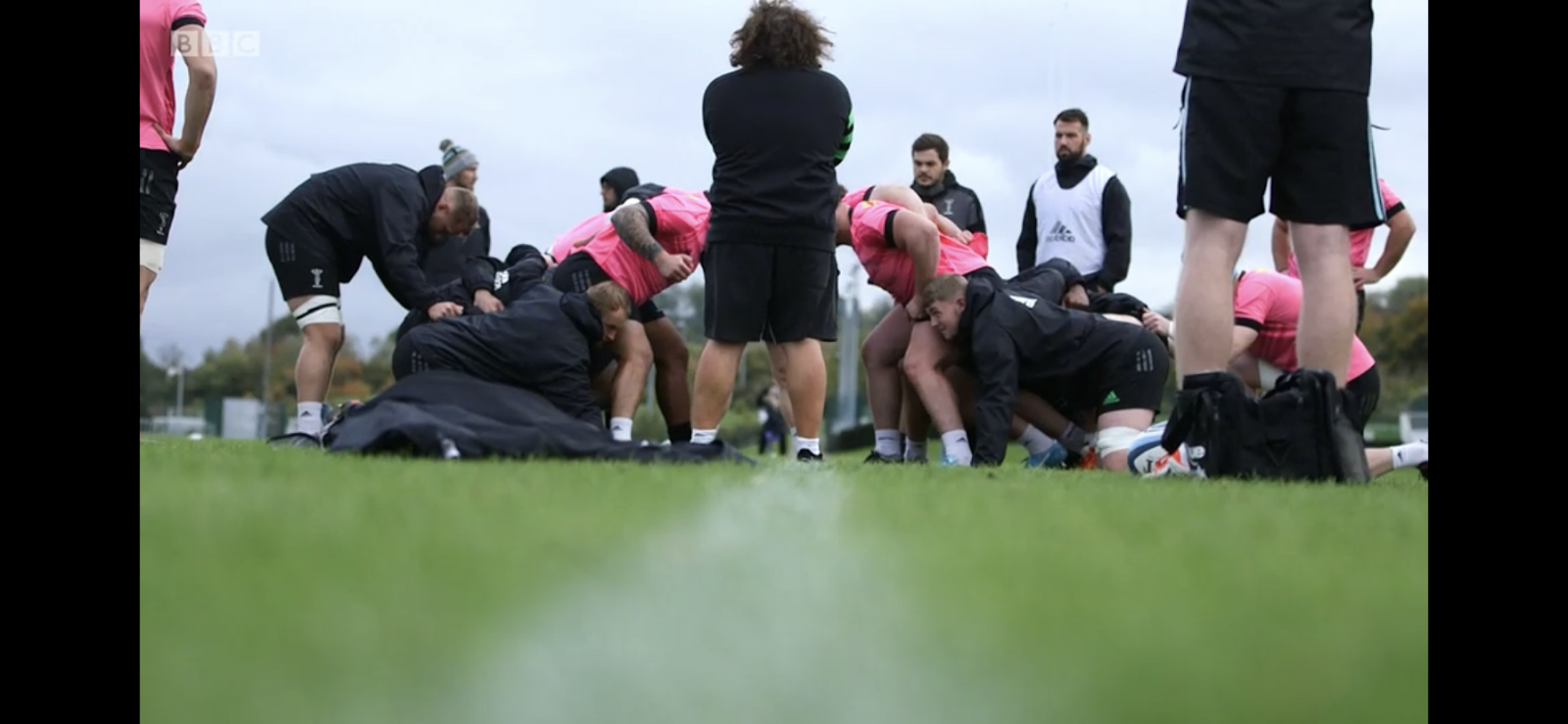
 These are some of the screenshots I took of the opening 5 minutes.


Other games, not necessarily the Harlequins, are featured whilst presenter Eleanor Roper discusses the sport of rugby during this establishing shot.


Behind the scenes of a less competitive, and more jokey team. The use of this shot is to anchor perhaps that these professionals are not always serious and have down time also. It is good to have many shots of the team in different circumstances also.

This mid shot of player Mike Brown in an emotional speech also anchors to the audience of that the sport is difficult, and with problems such as the world cup choices of players and dreams not coming to plan have an effect on them, and this show allows a real insight into their true identity.

The title is bold and clear for the audience, something I need to make sure I emulate. Furthermore, the use of three 't's' becomes a memorable title for the show, which is important.
The following 3 varying shot types establish the hard work and training that go into the Harlequin team's success. This is important to show to the audience that there is a lot that goes on behind the scenes to have the success they do.

This close up shot of warm-ups is different to the shot before as it is at night during a friendly game, and so practising is consistent and takes place at any time. I think this is an interesting idea to include, and certainly something I can emulate for my audience for showjumping as it is certainly a 24/7 lifestyle.


This shot is interesting of online articles about Saracens and the scandal that took place.. I could possibly include the idea of drugging horses/riders for better performances within the documentary, or alternatively include this on the website.


Many interviews took place within the opening 5 minutes, including Chris Robshaw, who had his hopes set on competing for England but did not make the team. It shows an insight to his reaction to not being chosen and how he wished to improve his chances for the following world cup.
Setbacks are important to show that this is not always a sport that goes to plan.

However, there are good moments of success and happiness, as they win another game and celebrate in the changing rooms, behind the scenes. Again it shows a sense of reality, that the good outweigh the bad, and that they are a hardworking team. I want to emulate this to my audience through Harry Bateman, that not all ideas go to plan, however when they do they are well celebrated and deserved through hard work and determination.


Wednesday, 1 April 2020

Audience Research: Feedback on pitch

 With the initial idea of Harry Bateman: Grassroots amateur too international star, I had hoped some would prefer improvement to the name as I felt it needed to be shorter and more memorable to the audience. Overall I am happy that 8 out of 12 had a positive response.


The qualitative response to question 2 was what I had hoped for, with some recommending shortening to just 'Bateman:...' rather than his full name.
Some struggled to understand the term 'grassroots' so it may be an idea to adapt this so a wider audience can understand the title.
I also understand how the term grassroots may be an intriguing aspect to the audience, to understand what this is by watching the show and looking on the website, so it may possibly work in some cases.

 The overall response to question 3 was positive, that my idea of using Harry Bateman and his sport as my talent will work for the audience specified by the exam board. This gives me a good grounding that I can  move forward in my ideas.
With question 4, and 4 saying that more links for engagement are needed, I think this could be solved by including links both online and in the video for how to get involved with the sport if they feel inspired to do so. This could be to websites such as British showjumping or British horse society.

The main response to question 5 is that additional videos of training would be successful, and then following in with links to get involved or see more.
Another suggestion as a way to get the audience involved is by sending in pictures of their own horses, or people getting involved with the sport in other ways too. I really like this idea and I think it would be great to include it.
The website is a great place to include more links to many different societies and groups, creating a feel of involvement for the audience with the show.
 The feedback from question 6 gave me many different features I had initially forgotten about.
A competition is a fantastic way to get the audience to visit online and sign up to newsletters also, and I could achieve this by having a competition to win tickets for HOYS, The horse of the year show. This show is not only for equestrians, but for audiences who want to experience something new, so is really suited
The idea of setbacks during his journey is great to show realism, and that every road is not smooth. It would be a great addition to the website, and as a way to show to the audience how the sport has its negative sides also, where it is extremely dangerous.
 Although one member stated that the idea of intertextuality should not be included, I think it would be a good way to encourage reading of other successful sportsmen for the audience.
Majority said that this should be included on the website, of which I agree, as it allows audio visual content to also be featured, or just an audio of Harry describing the texts and how he enjoys them.
With the final question, I can see that some think more intertextuality is needed, of which i will have to think some more about how I will achieve this.
Furthermore, I can widen ideas to the Olympics, and this can be mentioned in both forms, such as a news update on the teams for the Olympics, international competitions and so on.

The feedback I have gathered has helped me tweak my ideas in some ways, and finalise that this idea can be successful if shot and made correctly both in documentary and online, so I am positive with what I received.

Thursday, 26 March 2020

Planning: Mood board


Planning: Pitch


Brief 1, a three minute opening sequence of a documentary for BBC Three.
So far I have made a temporary name for my documentary, but is subject to change. Having taken a look at the typical BBC 3 documentary and their titles, I have decided for mine to be Harry Bateman: grassroots amateur to international star.
Harry Bateman is a 24 year old International showjumper from Hockley, and has built his show-jumping career out of his back garden with the help of his family. My idea of using this sport is that it is out of the ordinary and does not have much coverage compared to sports such as football and an audience will more likely engage with a new topic. Furthermore, the opening sequence will introduce how the talent juggles between sport and social life, and introduce his achievements to the audience. He is of an ideal age as he fits within the bracket of the audience (16-25). The opening sequence will include a range of shot types across the talent's home, including a tack room, stables and arena, as well as surrounding countryside. 
Throughout the opening 3 minute sequence it will include hashtags and online social media platforms underneath, in order to encourage the 16-25 audience to engage and give their opinion, as they are more likely to do so when prompted. Also, within the sequence the presenter can mention their online presence, such as the website, BBC3 itself and iPlayer for their other documentaries available, showing convergence across platforms. Should the audience enjoy the documentary they will be more likely to engage further in similar types of show or discover others online as a result. The style of BBC3 documentaries is important and must be adhered to in order to uphold their professional style.
The website itself must also be in the house style of BBC3, and must have individual shots of the talent and the sport to appeal and anchor the topic of the show. The website will feature audio-visual content, such as a Q&A that the audience could have suggested questions to ask. Also this could allow some intertextual reference in terms of the talent’s idols, with Nick Skelton and Tim Stockdale having written their autobiographies. Another form of audio-visual is a day in the life of them like a daily routine and schedule, or a show preparation. There will also be twitter/Instagram posts on the website, encouraging the audience reading them to engage also as an active audience and opportunities for the audience to follow the talent online and visit their instagram/twitter account.

Tuesday, 24 March 2020

Planning: Reflection on moderator's report

Television Documentary moderator's report:
- In the statement of intent, I need to make the amount of detail about the website equal to the video, as they both hold the same importance.
- What I intend to achieve in terms of the brief, but without repeating it. It is worth 10 marks so is certainly important to get it right.
- I need to establish many shot types from the very beginning of the talent and the locations available, such as wide, close up, panning etc. This will establish the setting and beginning of the documentary.
- It is good to introduce what happens later on in the documentary to engage the audience from the beginning, and show what is to be expected.
The lighting and editing needs to be strong and correct, much like other BBC3 documentaries to uphold their professional style.
- What I hadn't originally thought about was adding links and accounts such as Twitter and Instagram into the beginning of the documentary. This engages the audience and shows convergence between media platforms, which is important to have.
- The examiners report claims websites to be problematic, and lacking detail. What is important to remember is that the video and the website hold the same amount of weight mark-wise, and so the website is just as important as the video itself.
-The house style of the channel the programme is made for must be upheld and suitable also.
- Do not use the templates given by Wix, personalise them to make the website better linked to the tv show, so it could be a good idea to use shots/stills of the presenter in the background or other sports to anchor the branding of the title.
- Examples of tweets and Instagram posts are a good way to engage audience interaction.
- The documentary needs to have clear convergence between media to be successful.

Sunday, 22 March 2020

Planning


I have made some brief ideas for my NEA for both TV documentary and music video. I have chosen TV due to how my talent will be available more often, and with the coronavirus issue my talent lives next door, so makes it a bit easier for myself to gain footage and keep returning for more. Furthermore, with the unavailability of public locations due to this virus it makes locations for music video less than I would prefer.
An opening of a sport documentary may be more interesting for the age group identified, and using talent inside this bracket will also engage the audience more, as they can identity with him more than other ages.
I plan to watch some BBC3 documentaries in order to understand their format and introduction in the beginning, and adapt to the techniques they use.
With the idea of using equestrianism in my documentary it will be a different topic  hopefully to the audience, which will engage a higher amount of people compared to something they have seen many times before.
So far, the title i have thought of is "Sport Daily", however I would like to adapt this to something better.
The locations I have planned so far are the talent's own home, with this arena and stables that will allow many shot types to be used. Another location available is the fields surrounding the talent's home, of which allows long distance filming and a change of mise-en-scene.

Website walkthrough

  https://vimeo.com/527032788